


Key Takeaways
- ISO 20022 enables richer payment data: Structured financial messages can improve automation, reconciliation, compliance, fraud monitoring, and payment investigations.
- The opportunity goes beyond compliance: Financial institutions can use ISO 20022 as a foundation for broader payments modernisation and innovation.
- Interoperability is a key advantage: A common messaging standard can strengthen connectivity across banks, clearing systems, payment networks, and domestic and cross-border services.
- Zambia can benefit from greater regional connectivity: ISO 20022 can help position the country’s financial ecosystem for more efficient integration with evolving African and international payment infrastructures.
- Infrastructure will determine the value: Banks need payment environments capable of processing, orchestrating, and using richer data effectively to realise the full benefits of ISO 20022.
About the Author:
Avinash has a wealth of knowledge and expertise in the Financial Services Industry, where he has excelled in both operational and business roles. With a strong understanding of Africa’s Payments landscape, he is committed to driving innovation and delivering impactful products tailored to the region’s unique challenges.
Avinash Naidoo
Product Manager: Payments and Clearing
As Zambia continues to modernise its payments landscape, the ability of banks, payment systems, and financial institutions to exchange richer, more structured information is becoming increasingly important.
ISO 20022 sits at the centre of this transformation.
While it may sound like another technical banking standard, ISO 20022 represents one of the most significant changes to the global payments landscape in decades. Across the world, central banks, payment schemes, and financial institutions are adopting it as a common language for financial messaging. From domestic clearing and real-time payment systems to SWIFT and cross-border payments, ISO 20022 is changing not only how transactions are exchanged but how payment information can be used to improve automation, interoperability, compliance, and customer experiences.
For Zambia, the opportunity therefore extends beyond adopting a new messaging standard. It is about creating the foundation for a more connected, data-rich, and future-ready payments ecosystem.
What Is ISO 20022 and What Changes?
ISO 20022 is an international standard for exchanging electronic financial messages. In simple terms, it allows significantly richer and more structured information to travel alongside a payment. Where traditional payment messages may contain relatively limited information, ISO 20022 can provide much greater detail about the payer, beneficiary, payment purpose, invoice or remittance references, regulatory information, and other transaction data. The difference can be compared to moving from a basic text message to a structured digital document.
Historically, individual payment networks developed their own messaging formats. This resulted in fragmented payment environments where systems often interpreted, translated, and processed information differently. The consequences could include manual intervention, difficult reconciliation, reduced interoperability, higher operational complexity, and slower innovation.
ISO 20022 introduces a common structure that enables participating systems and institutions to exchange information more consistently.
The value, however, is not simply in standardising the message. It is in what financial institutions can do with the richer information contained within it. Better structured data can improve straight-through processing, assist automated reconciliation, strengthen regulatory reporting, support fraud and sanctions controls, and enable banks to resolve payment queries more efficiently.
That is where ISO 20022 begins to move from being a technical standard to becoming an enabler of broader payments transformation.
What Does ISO 20022 Mean in Practice?
For consumers, the technology itself will largely remain invisible. The impact will instead be experienced through better payment services.
More complete transaction information can make payments easier to identify, while banks may be able to investigate queries more quickly because richer data is available throughout the transaction lifecycle. Structured information can also support more effective fraud monitoring and the development of smarter digital services.
For banks, the opportunity is primarily operational and strategic.
Richer payment information can support:
Greater straight-through processing and reduced manual intervention.
Improved reconciliation between payments, accounts, and invoices.
Stronger AML, sanctions, fraud, and regulatory reporting processes.
Faster investigation and resolution of customer payment queries.
More consistent integration across payment systems and channels.
A stronger foundation for developing new digital payment services.
At an industry level, ISO 20022 also creates a common language that can improve interoperability between financial institutions, clearing systems, and payment networks. This becomes increasingly important as payment environments become more interconnected and customers expect money to move quickly and transparently across different institutions, channels, and borders.
ISO 20022 and the Next Generation of Payments

Perhaps the biggest opportunity created by ISO 20022 is not the migration itself, but what comes next. Payment ecosystems are evolving rapidly. Financial institutions are increasingly operating across real-time payments, API-driven banking, digital wallets, open banking, and more connected cross-border services.
At the same time, emerging models such as digital currencies, tokenised assets, and stablecoin-based payment rails are changing how the financial services industry thinks about the movement of value. In this environment, data becomes increasingly important. Payments can no longer be viewed simply as instructions to move money between accounts. The information surrounding the payment can become an equally valuable asset.
Richer and more structured data can support greater automation, more intelligent fraud and compliance controls, improved reconciliation, and increasingly personalised financial services.
The institutions that derive the greatest value from ISO 20022 will therefore be those that look beyond message conversion and consider how richer payment data can support new products, smarter operations, and more connected customer experiences.
The migration should not simply answer the question: ‘How do we become ISO 20022 compliant?’
The more strategic question is: ‘What can we now do differently because our payment infrastructure and data are richer, more standardised, and more interoperable?’
That distinction is important because compliance may initiate the investment, but innovation should ultimately determine the value derived from it.
Why Does ISO 20022 Matter for Zambia?
A Changing Payments Landscape
Zambia’s move towards ISO 20022 should be viewed within the broader transformation of the country’s payments landscape. As digital transaction volumes increase, and payment ecosystems become more interconnected, financial institutions need infrastructure capable of supporting faster processing, richer information, and greater interoperability.
Meeting New Industry Demands
At the same time, banks must respond to increasing expectations around regulatory reporting, fraud prevention, operational efficiency, and customer experience. ISO 20022 provides an important foundation for addressing these requirements.
Modernising Zambia’s Payments Ecosystem
For Zambia, the transition creates opportunities to modernise payment infrastructure, improve interoperability between financial institutions, strengthen regulatory reporting and fraud controls, and improve payment experiences for businesses and consumers. Importantly, the opportunity extends beyond domestic payments.
Enabling Regional & International Connectivity
The use of a common international messaging standard can make it easier for Zambia’s financial ecosystem to interact with regional and international payment infrastructures as cross-border interoperability continues to evolve. This is increasingly relevant as African payment ecosystems become more connected and regional initiatives seek to make moving money between countries faster, simpler, and more transparent.
Creating Value Through Richer Data
For businesses, richer remittance and payment information can also improve reconciliation and cash-flow visibility. For financial institutions, the ability to process and interpret structured payment data consistently can reduce operational complexity while supporting new digital services.
Preparing for the Future of Payments
ISO 20022 should therefore not be viewed as an isolated technology programme. It is one component of a broader payments modernisation journey that can prepare Zambia’s financial sector for greater domestic efficiency, regional connectivity, and future payments innovation.
Beyond Compliance: Turning Migration into Opportunity
The institutions that benefit most from ISO 20022 may not necessarily be those that complete the migration first. The greater opportunity lies with those that find ways to extract value from the richer data the standard creates. Compliance may be the catalyst for change, but innovation should be the outcome.
Banks can use the transition as an opportunity to examine legacy payment processes, reduce manual intervention, improve reconciliation, strengthen risk controls, and simplify how different payment systems are integrated. It can also create the foundation for more intelligent payment services and better customer experiences.
This requires financial institutions to think beyond individual message formats and consider the broader architecture surrounding payments.
Can the organisation process richer payment information end to end?
Can it route transactions intelligently between different payment rails?
Can operational teams see and resolve exceptions efficiently?
Can compliance and fraud systems make better use of the additional transaction data?
Can new payment services be introduced without creating another isolated technology stack?
How Sybrin Supports ISO 20022 Transformation
Successfully adopting ISO 20022 requires more than translating one message format into another. Financial institutions need payment infrastructure capable of validating, processing, orchestrating, and managing richer payment information across multiple payment rails. Sybrin’s Payments and Clearing technology stack is designed to support this broader transformation by providing the orchestration, integration, and operational capabilities required to connect payment channels, banking systems, and clearing infrastructure.
With more than three decades of experience delivering payment solutions across Africa, Sybrin has developed capabilities spanning Payments Hub, ACH Manager, Cross-Border Payments, and Corporate-to-Bank solutions.
Together, these capabilities enable institutions to support ISO 20022 messaging while building scalable and resilient payment environments that can evolve as the payments landscape changes.
The objective is not simply to help institutions exchange a different type of payment message. It is to help create payment environments that are more connected, easier to operate, and better positioned to support new payment services, regulatory requirements, and emerging rails.
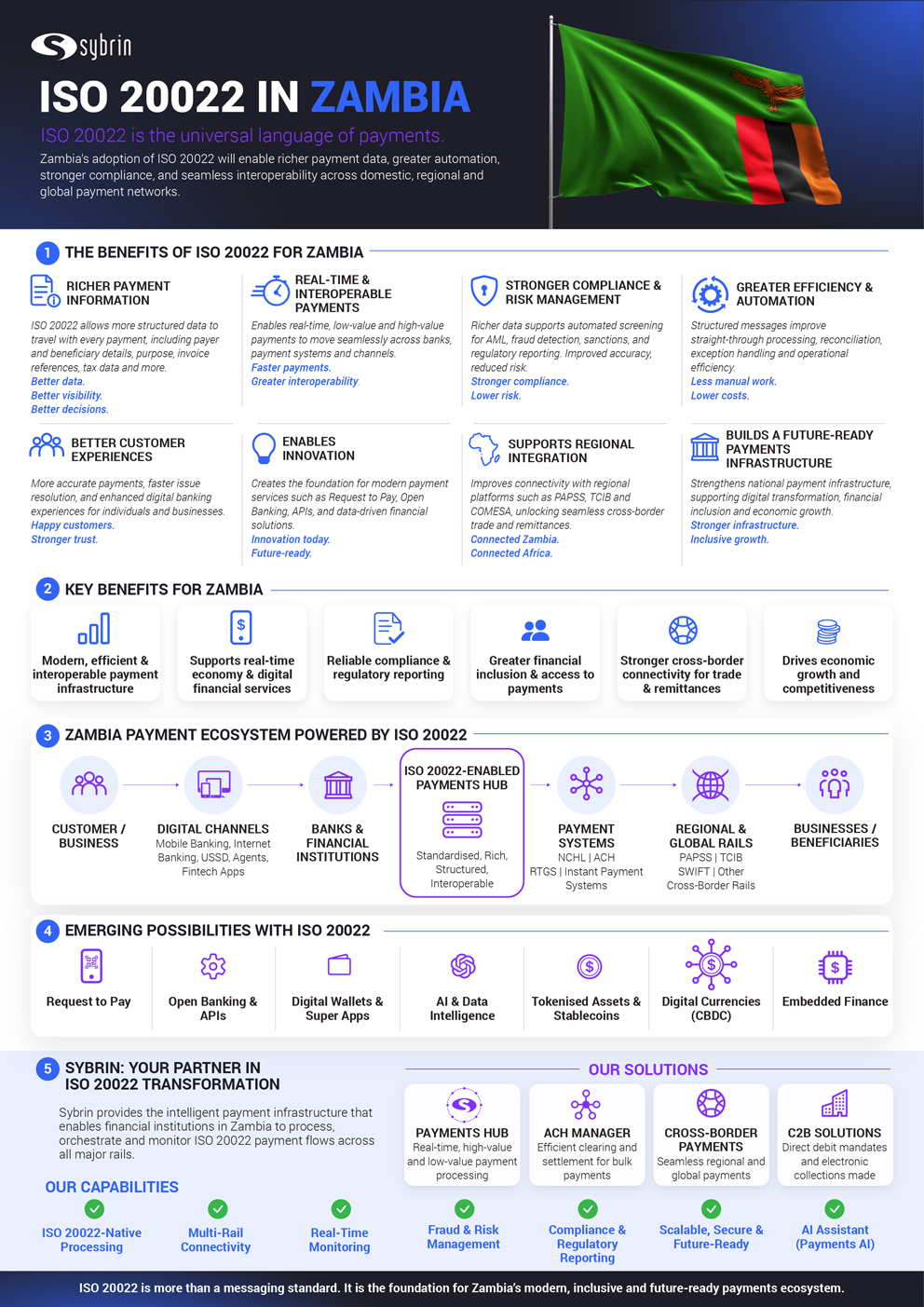
Building the Future of Payments
ISO 20022 is much more than a new messaging standard.
For Zambia, it represents an opportunity to strengthen the foundation of the country’s payments ecosystem while preparing financial institutions for a future defined by richer data, greater interoperability, and increasingly connected domestic and cross-border services.
The migration may begin as a technology or compliance requirement, but its real value will depend on what the industry builds on top of it.
Banks and payment providers that use the transition to modernise infrastructure, improve operational intelligence, and create more flexible payment environments will be better positioned to respond as customer expectations, regulation, and payment technology continue to evolve.
The future of payments will not be defined by a single payment rail or messaging standard. It will be defined by connected ecosystems capable of moving money and information securely, intelligently, and seamlessly.
For Zambia, ISO 20022 is an important step in building that future.
Ready to build a more connected, ISO 20022-ready payments environment? Talk to Sybrin about the next step in your payments modernisation journey.