


Key Takeaways
- Digital payment growth demands a connected collections ecosystem, not just faster payment processing.
- Fragmented collections systems increase revenue leakage, manual work, reconciliation complexity, and compliance risk.
- Successful collections span the entire lifecycle, from customer onboarding and mandate management to reconciliation and reporting.
- A connected collections operating model improves visibility, governance, operational efficiency, and customer experience.
- Organisations that modernise their collections lifecycle will be better positioned to protect revenue, improve resilience, and support future payment innovation.
According to the World Bank Global Findex, digital financial services continue to expand rapidly across emerging markets, with increasing account ownership and digital payment adoption fundamentally changing how consumers and businesses interact with financial institutions. As payment options become more diverse, the operational challenge is no longer simply moving money; it is managing increasingly complex collections processes. For banks, insurers, lenders, utilities, and telecommunications providers, recurring payment collections remain essential to maintaining predictable cash flow.
An insurer collecting monthly premiums, for example, must ensure customer mandates remain valid, collection instructions are generated correctly, exceptions are resolved quickly, and settlement outcomes are accurately reconciled. A lender collecting loan repayments faces many of the same challenges, while utilities, schools, and telecommunications providers depend on equally reliable recurring payment processes.
As payment ecosystems become increasingly interconnected, collections involve far more than simply initiating a debit instruction.
The Hidden Cost of Fragmented Collections
Many organisations have invested heavily in digitising customer onboarding and payment channels, yet collections often remain fragmented behind the scenes.
Different systems manage customer onboarding, mandate authorisation, payment processing, reconciliation, reporting, and customer communication independently. While each component may perform well on its own, the lack of integration creates operational friction throughout the collection lifecycle.
The consequences are familiar across financial institutions and corporates alike:
Revenue leakage from failed or delayed collections.
Increased manual effort to resolve unpaid items.
Complex reconciliation across multiple payment systems.
Weak visibility into collection outcomes.
Greater operational and compliance risk.
Poor customer experiences caused by disputes and delays.
Ironically, the more digital payment options become available, the greater the need for collections processes that can coordinate them effectively. Modern collections are no longer a back-office function, they have become a strategic operational capability.
Collections Are No Longer Transactions, They Are Ecosystems
A common misconception is that collections begin when a debit instruction is submitted. In reality, successful collections begin much earlier and continue long after funds have been processed.
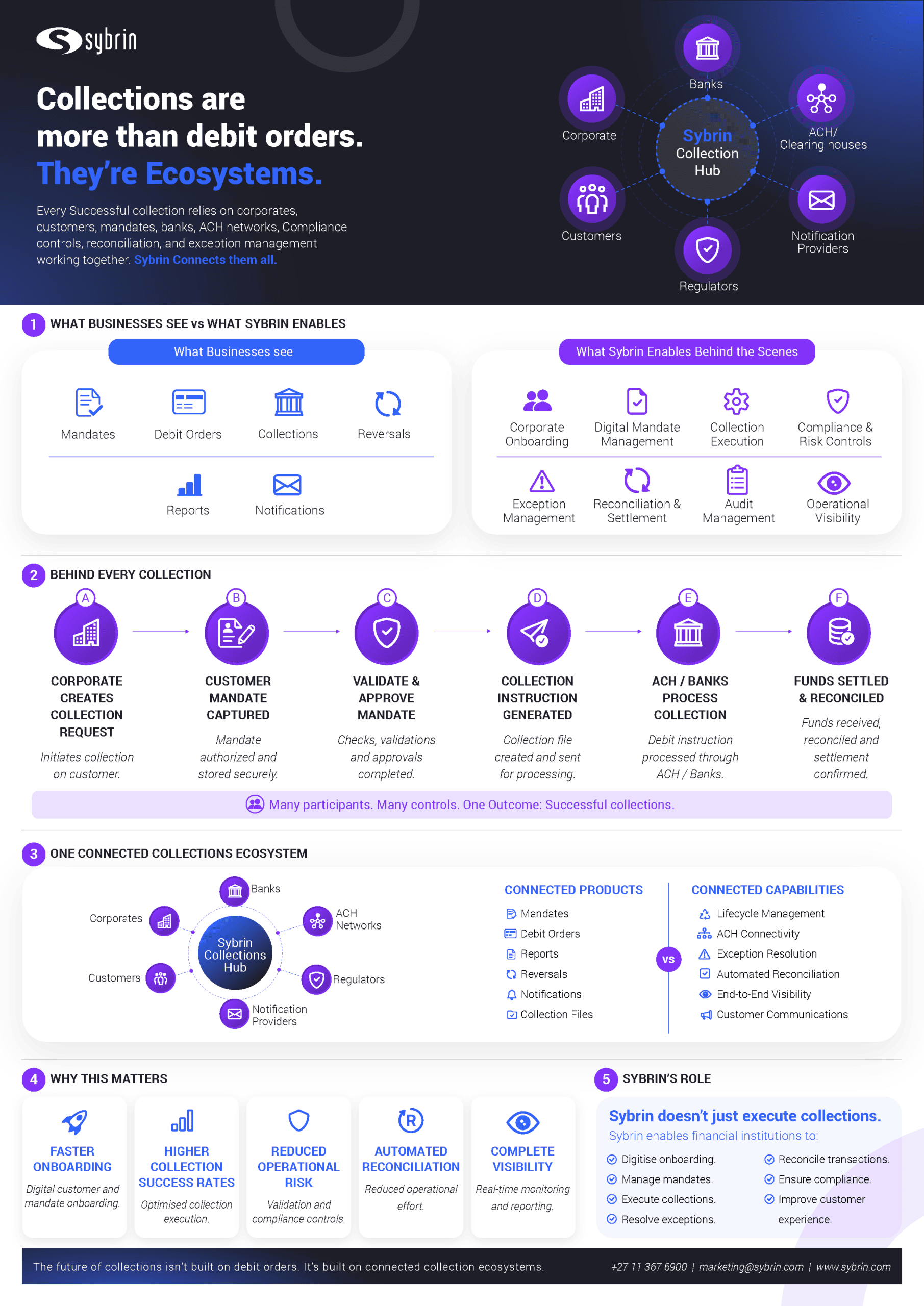
Every recurring collection relies on a sequence of connected activities that include corporate onboarding, customer mandate management, payment execution, exception handling, reconciliation, reporting and ongoing lifecycle management.
This is why leading financial institutions are increasingly viewing collections as a connected operating model rather than a collection of independent systems.
Rather than viewing debit orders as isolated payment events, organisations should consider the entire operational journey.
Customer information must be captured accurately.
Mandates must be authorised and governed.
Collection instructions must be validated before execution.
Exceptions require structured workflows rather than manual intervention.
Settlement outcomes need to be reconciled.
Customers, corporates and operational teams all require visibility into the status of every collection.
Only when these components operate together does the collections process become predictable, scalable and resilient.
The Modern Collections Ecosystems
Modern collections extend far beyond payment execution. They require a connected operating model that links onboarding, payment instructions, exception management, reconciliation, and operating reporting into a single governed lifecycle.
The info graphic illustrates how each stage of the collections journey contributes to a more controlled, transparent, and efficient collection operating model.
Enabling Connected Collections
As organisations modernise their payment ecosystems, the technology supporting collections should enable business outcomes rather than become another operational silo.
A connected collections operating model brings together customer onboarding, collection management, payment execution, exception handling, reconciliation, and reporting into a single governed process. This approach helps financial institutions improve operational visibility, strengthen governance, and deliver a more consistent collections experience for corporate clients and their customers.
Avinash Naidoo
Product Manger: Payment and Clearing
Sybrin supports this operating model by helping banks modernise collections across the full lifecycle, enabling organisations to simplify operations while improving control, transparency, and customer experience.
Looking Ahead
Digital payments will continue to evolve. The organisations that differentiate themselves will not necessarily be those with the greatest number of payment channels, but those that manage the entire collections lifecycle with greater visibility, stringer governance, and more efficient operations.
Collections are no longer simply about moving money. They have become a strategic capability that protects revenue, strengthens customer relationship, and improves operational resilience. If your organisation is revieing how collections are managed today, now is the time to rethink the operating model behind every recurring payment.
Contact Sybrin to discuss how a connected collections ecosystem can help modernise your collections strategy.