


Key Takeaways
- Legacy onboarding processes slow customer acquisition, increase costs, and create compliance and operational risks.
- Digital onboarding enables faster, self-service customer journeys while improving compliance and scalability.
- Automation streamlines identity verification, compliance checks, and workflows, allowing teams to focus on higher-value tasks.
- Successful modernisation depends on phased implementation, seamless integration, and strong organisational change management.
- The future of onboarding is AI-driven, intelligent, and personalised, combining compliance and customer experience into a single seamless journey.
From Paper to Self-Service: Modernising Legacy Onboarding
Interview with Sean Botha – Product Manager: Hyperautomation
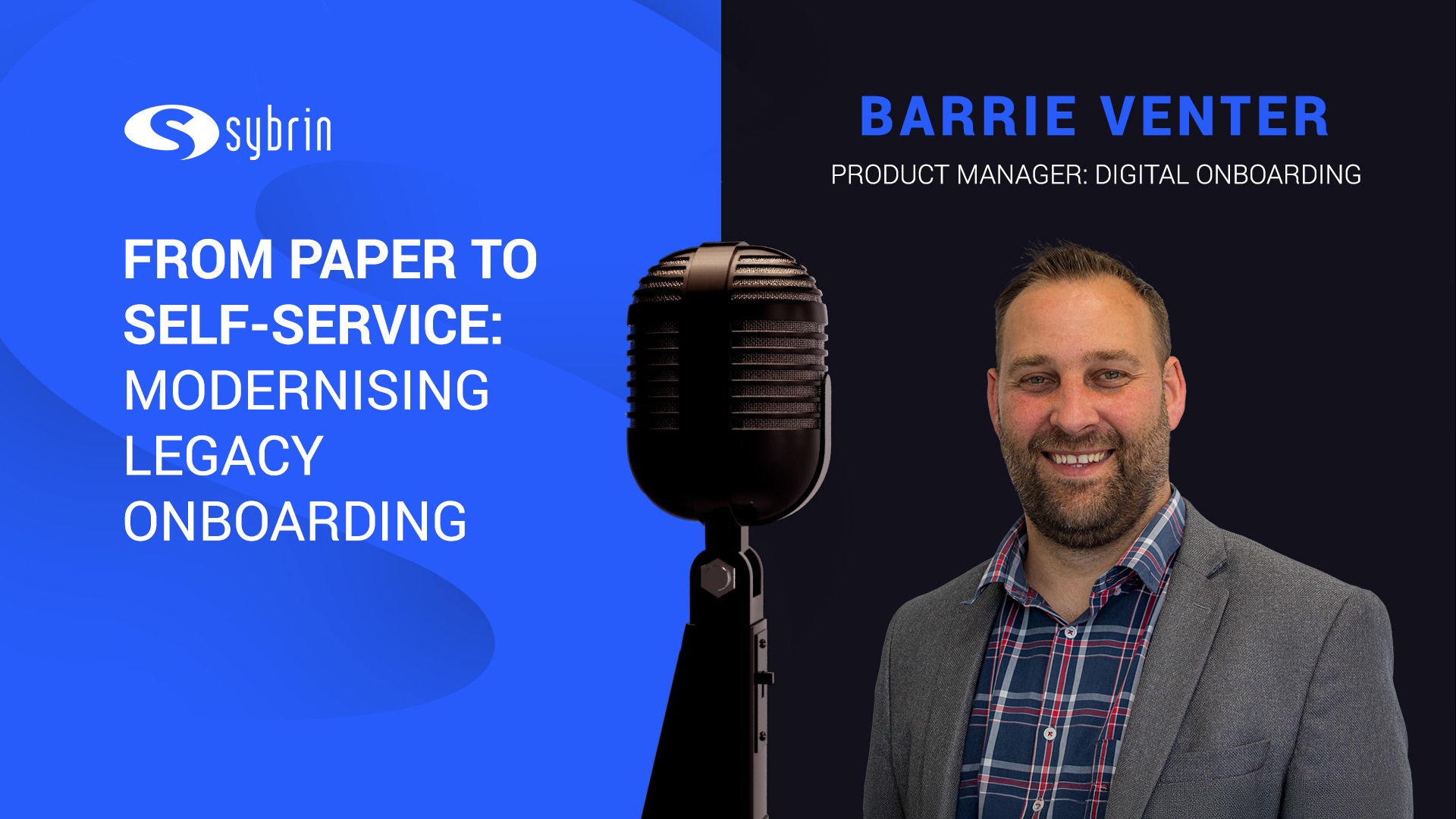
Legacy onboarding systems have long been the backbone of financial institutions, but as customer expectations evolve, those systems are showing their age. In this interview, we sat down with Barrie Venter, Sybrin’s Product Manager for Digital Onboarding, to discuss the risks of legacy processes, the promise of automation, and the future of customer onboarding in the era of AI and real-time intelligence.
Why Financial Institutions Still Rely on Legacy Onboarding
According to Barrie, many institutions are still bound by deeply entrenched systems that have evolved over years of costly customisations. “Legacy systems are embedded into organisations,” he explained. “Over time they’ve become stickier, and many fear that modernisation could disrupt compliance or customer service.”
It’s less about resistance to innovation, he added, and more about risk aversion — concerns over disruption, adaptation, and compliance risks that come with transformation.
Why Hyperautomation Matters in Modern Financial Ecosystems
Financial services operate in environments defined by:
- Legacy systems
- Regulatory intensity
- Rising customer expectations
- Rapidly evolving technology
According to Sean, hyperautomation helps institutions cut through this complexity. “By connecting ecosystem components end-to-end, organisations gain resilience, adaptability, and a faster path to digitisation and innovation.”
The Risks of Standing Still
Manual onboarding comes with a wide range of compliance, customer experience, and efficiency risks. Barrie noted that manual processes invite errors and inconsistencies: “You’re dealing with outdated checklists, paper-based workflows, and long branch waiting times. It’s not scalable, and it’s not sustainable.”
The result? Slower onboarding, higher costs, and reduced customer satisfaction, all of which hinder competitiveness in today’s digital-first world.
Barriers to Modernisation
Transforming legacy onboarding isn’t easy. The biggest barriers, Barrie explained, are integration challenges, budget limitations, and change management.
“Modernising onboarding requires both technical and organisational readiness,” he said. “The key is executive sponsorship and phased delivery; ensuring teams are aligned, budgets are realistic, and integration is carefully planned.”
From Paper to Digital: The Key Benefits
The shift to digital onboarding delivers measurable value almost immediately. “Onboarding times can drop from days to minutes,” said Barrie. “Customers can onboard via self-service channels, compliance is improved through built-in controls, and scaling no longer depends on physical branches.” He emphasised that the ability to onboard anywhere, anytime is one of digital transformation’s biggest competitive advantages.
Automation: The True Game-Changer
Automation reduces manual reviews, eliminates redundant checks, and enforces consistent decision-making.
“Your ID checks, PEP-screening, and data capture can all be automated,” Barrie explained. “Workflows are accelerated, freeing analysts to focus on higher-value decisions.” Automation not only boosts efficiency but ensures standardised, audit-ready compliance across every onboarding journey.
Achieving Seamless Integration
Integrating new platforms with existing core systems is often viewed as a major hurdle, but with the right architecture, it doesn’t have to be. Barrie recommended an API-first, modular approach, paired with phased rollout and cross-functional collaboration. “When IT, compliance, and operations work together, integration is far smoother,” he said.
Building Buy-In Through Training and Culture
Even the best technology fails without adoption. Barrie stressed the importance of change management and staff empowerment:
Train for outcomes. Link training to goals; compliance, customer experience, and efficiency. Appoint champions, recognise achievements, and celebrate progress.” A strong onboarding culture, he noted, ensures teams not only use new systems, but love using them.
Barrie Venter
Product Manger: Onboarding, ID Verification, and FRM
Managing Migration Risks
Migrating from legacy systems carries risks; from data corruption to process disruption — but they are manageable with planning and communication.
“The greatest risk is people rejecting the system,” Barrie said. “That’s why continuous engagement, proper testing, and clear communication are essential.”
Measuring ROI
The return on modernisation is both tangible and strategic. Barrie listed key benefits including:
- Reduced onboarding time and cost per acquisition
- Higher conversion rates thanks to smoother flows
- Stronger compliance posture through automation and auditability
“The efficiencies stack up quickly,” he added. “And the long-term ROI comes from scalability and customer satisfaction.”
The Future of Onboarding: Intelligent, Personalised, and Real-Time
Looking ahead, Barrie envisions a future defined by hyper-personalisation, local configurability, and AI-driven intelligence.
“At Sybrin, we’re focused on tailoring onboarding journeys based on channel, risk, and customer behaviour,” he said.
He predicts the next generation of platforms will be:
- AI-enhanced and low-code, for faster deployment
- Configurable in real-time, to adapt to new threats
- Unified, merging KYC, AML, and customer experience into one intelligent workflow
“The future of onboarding is intelligent orchestration,” Barrie concluded. “It’s about merging compliance and experience into a single, seamless journey.”
Final Thoughts
Modernising onboarding is no longer optional, it’s a strategic imperative. As Barrie put it:
“Legacy systems were built for yesterday’s customers. Intelligent onboarding is built for tomorrow’s.”
Sybrin’s Digital Onboarding platform empowers financial institutions to evolve from paper-heavy processes to agile, intelligent, and compliant ecosystems; driving efficiency, trust, and growth in every interaction.